How It Works
Nothing Performs Like OmniFunds.
Here's Why.
OmniFunds achieve their performance through the use of some very advanced concepts, including...
- Market States
- Filters & Rankers
- Selective Switching
- Multiple Portfolios
- Artificial Intelligence
Let's look at how these tools are used to craft the best possible Equity Switching Algorithms.
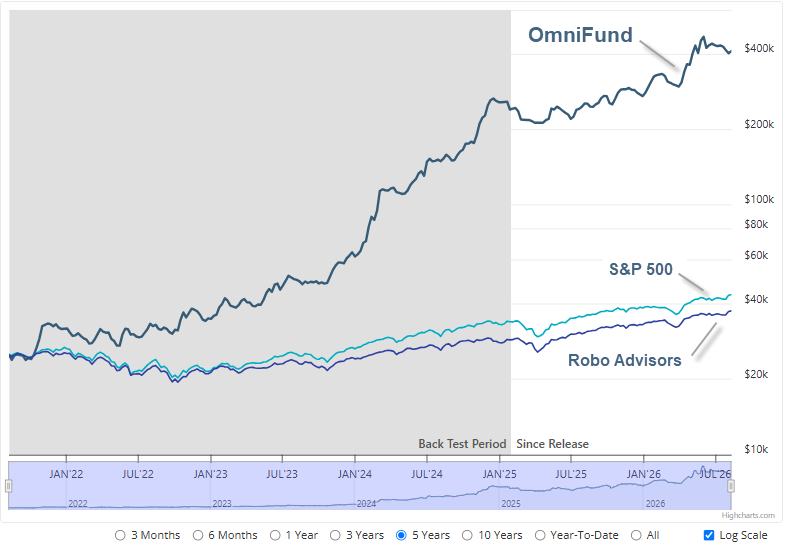
The NAS100 & Russell 3000 was released in early 2025 and is up over 65% in the past year. The S&P gained 21% in the same period.**
Market States
Want to Avoid Losses?
Avoid the down markets.
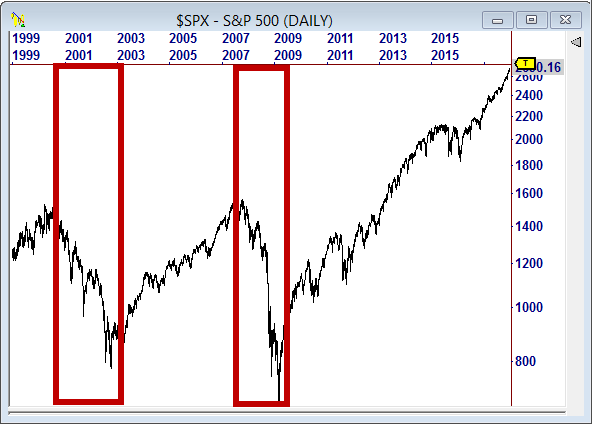
To the left is a chart of the S&P 500 index, representing the US stock market. We have highlighted two periods, 2001 and 2008. Each time, the market declined more than 50%, wiping out years of growth in the process.
Are losses during these periods mostly avoidable? If we can see the market is going down, why wouldn't we close our positions and get back in when the downturn is over? That's the first thing we do to create a robust OmniFund.
Using Market States
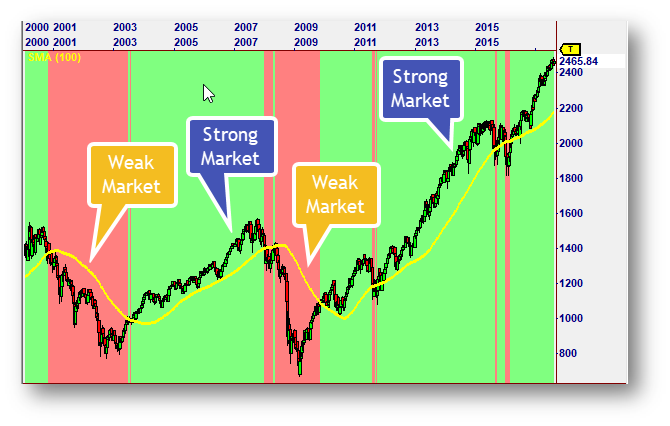
Here's the same chart with a Simple 100 Period Moving Average. If the index is above the average, the market is generally bullish (green zone) and new Long Positions can be engaged. If it's below the average, the market is bearish (red zone) and we should exit Long positions.
While the Market States used in our Omnifunds are more sophisticated, we can see that even using a Moving Average is better than just owning stocks at all times - like Advisors, and especially the Robo Advisors do.
Weekly Chart of the S&P 500
Filtering & Ranking
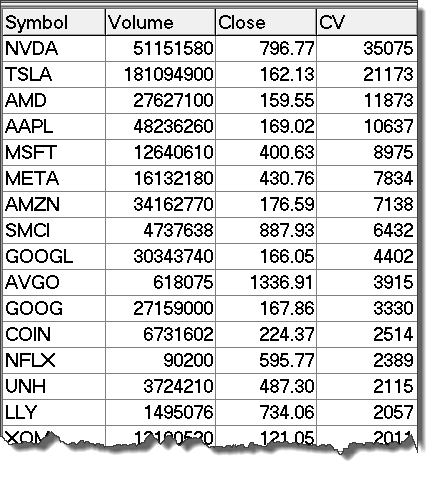
The most liquid stocks in May of 2024.
The CV Column is Price * Volume, in $ Millions.
Start with a Good List
There are over 10,000 equities in the U.S. Stock Market. Many of them are not "liquid" enough to be considered for switching.
The best liquidity filter is Money Flow, which is calculated as Average Price * Volume. Most of our OmniFunds have a lower limit on Money Flow of $100 million. So a $100 stock must trade an average of 1 million shares a day to qualify.
A single Portfolio may include stocks from a specific index, like the NASDAQ 100, or a given industry, such as Technology or Healthcare.
Filtering the List
While Liquidity is very important, we also look at factors that indicate a stock's probability of rising, including both chart and fundamental measurements. Some of these include:
- Recent Earnings
- Momentum
- General Trend
- Volatility
- and more..
We apply these Filters to get candidates that have "the right stuff" to consider for Opportunity Ranking.

Opportunity Ranking
We want to invest in stocks that have the highest probability of upward price movement. For example, we can sort our candidates from highest Momentum and rank each day's candidates on specific factor.
Selective Switching
The Selective Switching Process
at the Portfolio Level
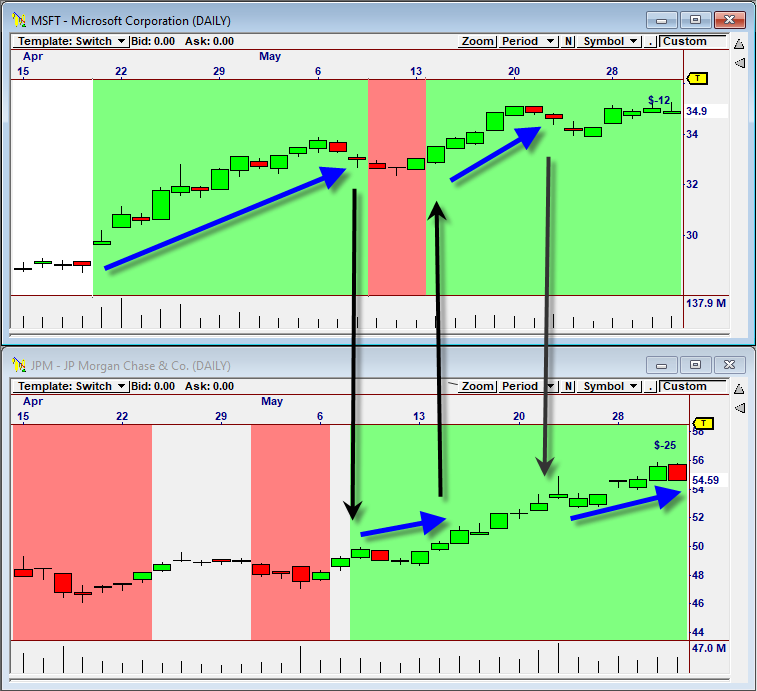
After applying Market States, Filtering and Ranking in a Portfolio, OmniFunds compares the Ranks with stocks that are already in the Portfolio, to see if any have a higher Rank. If so, it replaces them.
As shown in a hypothetical switching scenario, MSFT and JPM switch places as the rank of one takes the lead position over the other. By trading MSFT in April, the portfolio grows more rapidly than if both MSFT and JPM had been traded at the same time.
This is a key advantage of OmniFunds vs. most Advisors, and Robo Advisors. Rather than invest in index ETFs we trade the strongest stocks in the index.
Artificial intelligence
(AI Level only)
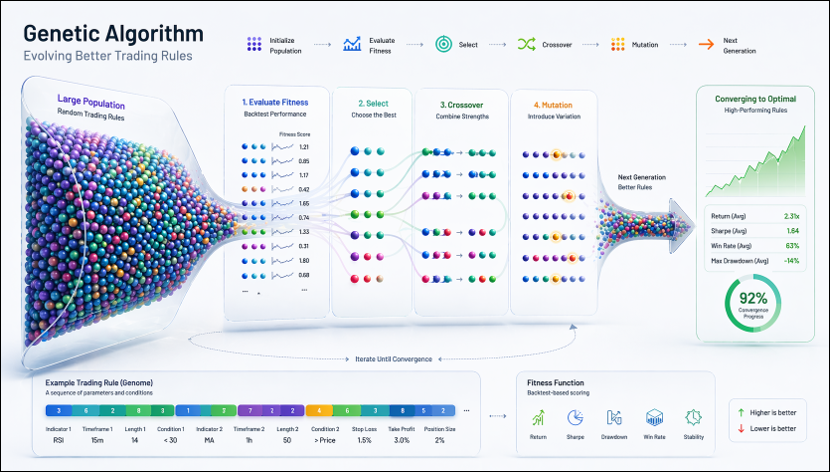
Thinks of Features as “Genes” and Rules as “Chromosomes”. The Genetic Algorithm builds populations of Chromosomes with hundreds of Genes each, and then applies the genetic concepts of “Crossover” and “Mutation” as it tests them in the historical data.
This process repeats millions of times as it finds hundreds and even thousands of Rules that show profitability in the Back Test. It then applies these Rules in out-of-sample data, a period marked “Since Release” in those OmniFunds that use A.I.
What about using ChatGPT, Claude and others? LLMs are good at solving statistical and mathematical problems, but since Markets are generally unpredictable, they’re not very good at picking stocks (We’ve tried.)
Nirvana DOES use LLMs for specialized data collection and analysis, but successful trading requires identifying situations with a high probability of success, which is what Genetic Algorithms are very good at.
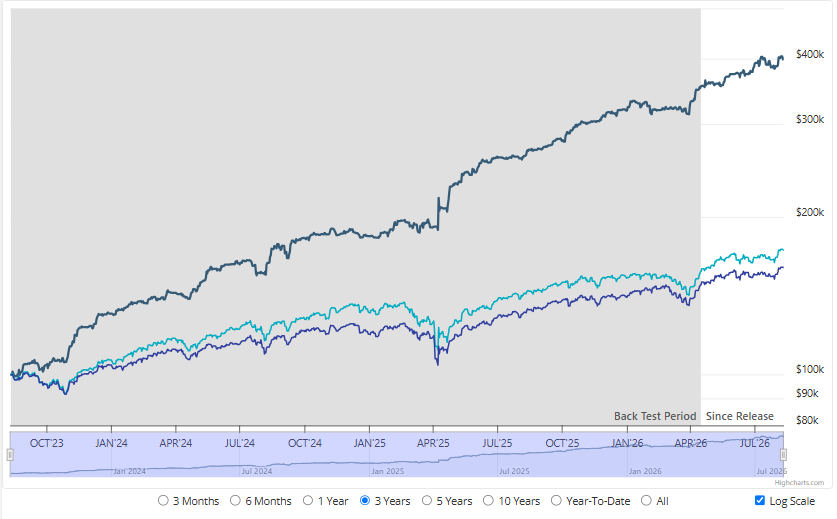
Model 2 is an OmniFund that is based on Nirvana AI. Other OmniFunds in the AI Level use software written by LLMs to analyze trends and find stocks to apply traditional (non-AI) algorithms to.
Combining Portfolios
for Added Diversification
Using Multiple Portfolios
to Create a Diversified OmniFund
The design and selection of each Portfolio is made by the designer who created it. Custom Symbol Lists, Market States, Filtering and Ranking combine to arrive at a final list of stocks for which positions should be held that represent each individual Portfolio.
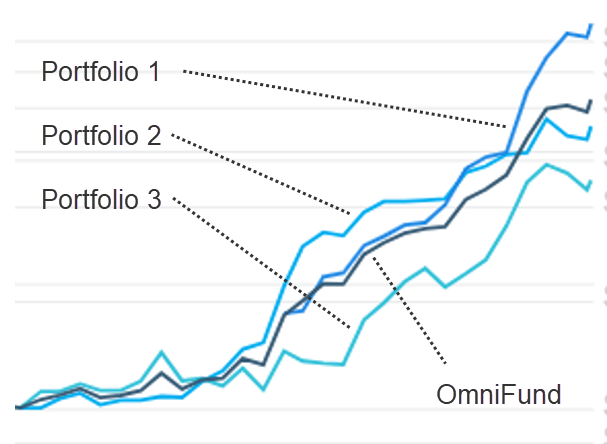
But OmniFunds are typically constructed using multiple Portfolios. The picture to the right shows three Portfolio performance curves. To create the OmniFund, 33% of the available capital is allocated to each one.
The stocks traded in the OmniFund are the stocks selected by each Portfolio. If a Portfolio does not have any candidates, its allocation is set to "cash".